
Geology and environmental science has been a part of the University of Pittsburgh's curriculum for over 150 years. To learn about each chapter in our department's history, please click on each of the tabs below!
- 1787 - 1896: Pittsburgh Academy & Western University of Pennsylvania
The University of Pittsburgh dates to 1787, when the Pittsburgh Academy was established in a log cabin in what is now downtown Pittsburgh. It become the Western University of Pennsylvania in 1819 and the first matriculating class graduated in 1823. Throughout the 1800s and early 1900s, the University campus moved multiple times, including following the 1845 Fire.
From 1864 to 1896, geology was taught as part of the natural sciences curriculum; however, a geology degree was not offered.

An engineering class at the Western University of Pennsylvania in 1895. - 1896 - 1917: University of Pittsburgh School of Mines
The School of Mines was formed as a School within the University in 1897. For the next twenty years, the School of Mines offered the University's first geology degree (a Bachelor of Science degree). In 1917, geology became a degree program in the Liberal Arts segment of the University (known at that time as the "College").
In 1908 the institution’s name was changed to the University of Pittsburgh. It was that year that the University moved from its location on the north side at the at the Allegheny Observatory site to the Oakland campus, where 43 acres of the Schenley Farms property had been acquired. The School of Mines building (the now-inexistent State Hall) was the first building constructed on the new campus.

State Hall, the former site of the School of Mines and the first building on the Oakland campus. The site of State Hall is now occupied by the Chevron Science Center. Undergraduate studies were emphasized in the University's early years, but graduate degrees in geology have been granted since 1912. Harry N. Eaton became the first Ph.D. in geology at the University of Pittsburgh, with a thesis entitled, “Geology of South Mountain and the Reading Hills, Pennsylvania."
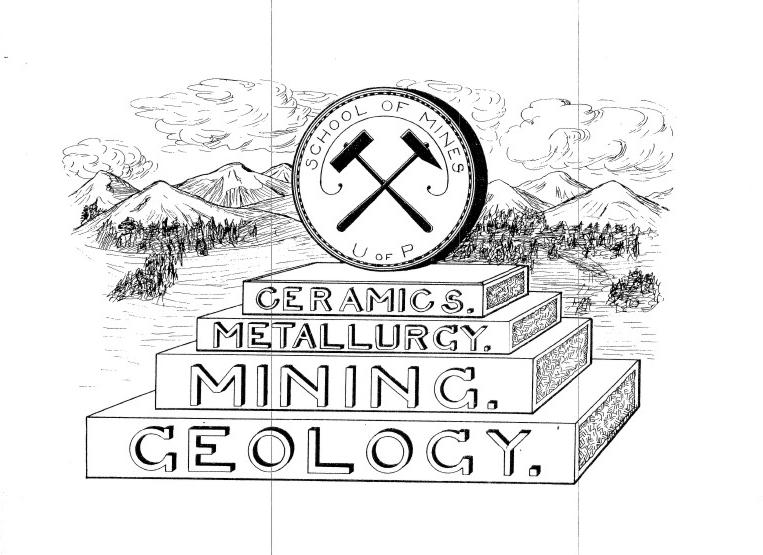
The School of Mines logo in 1910. - 1917 - 1960: Department of Geology, Department of Earth & Planetary Sciences
From 1917 until 1960, the name of the department was the Department of Geology (although between 1934 and 1944, the department also encompassed geography). In 1960, it was changed to the Department of Earth and Planetary Sciences, associated with a program expansion. As well as geology, the department now taught geophysics, geochemistry, and planetary science. A paradigm used was the TOPS focus—Tropics, Ocean, Polar, and Space.
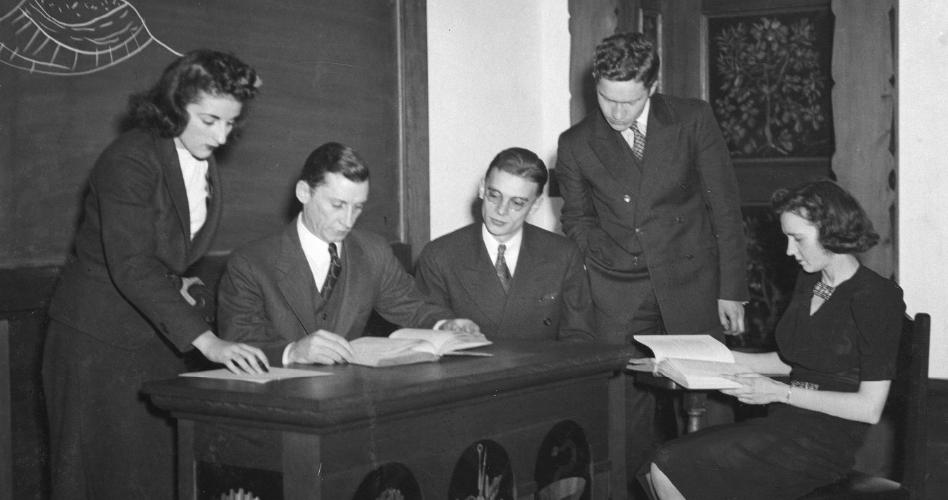
A geology class under the direction of Dr. Richard E. Sherrill (head of the department from 1944 to 1952) in session in the Czechoslovak classroom. The Czechoslovak room emphasizes education, leadership and a love of nature. This room, along with twenty five other Nationality Rooms all with different architectural styles, was conceived in the 1920s by sociologist Ruth Crawford Mitchell as a means of linking the university with the immigrant culture of the steel working families. Shortly after the Cathedral of Learning was completed in the late 1930s, a set of three instruments were installed: a Hugo Benioff short-period seismograph and two long-period horizonal pendulum instruments. John Gabbert Bowman, the University's Chancellor, had a fascination with seismology and wanted the University to have a "world-class" station. They even went so far as to install underground cables from the seismic vault in the Cathedral over to the newly completed Clapp Hall, where the recording instrumentation was to be on public view in the display cases on the Fifth Avenue side of the building.
However, the instruments did not do very well in this location because of passing streetcars. At the time, it was thought that this was due to the weight of cars as they passed, but further investigation in the 1960s relative to a similar site in Algeria showed that it was actually caused by the moving induction loop caused as the streetcar moved down the street.
The Cathedral's seismic vault was eventually abandoned, and while the two long-period instruments are no longer functional and their fate is unknown, the short-period seismograph was installed in the Carnegie Museum in the early 1980s, in whose custody it has remained ever since.
- 1960 - 2015: Department of Geology and Planetary Science
In 1979, geology was once again added to the department's name. Geology and Planetary Science remained the name until 2015.
Between 1960 and 1965, although undergraduate enrollment was diminishing, the graduate program was expanding. Graduate degrees (M.S. and Ph.D.) were granted in Geology and Planetary Science with students focusing in core areas like geology, geophysics, geochemistry, volcanology, and planetary science.
From 1973 to 1983, there was a steady increase again in student enrollment, to a peak of 100 undergraduate majors in 1983 (a record which has now been surpassed in recent years). Graduate student enrollment continued to climb until 1984, hitting a peak of 100 students (half of whom studied on a part-time basis).
The department moved to Clapp Hall in 1958 from the Cathedral of Learning, and moved again to Langley Hall in 1961. In 1976, it moved to O'Hara Street, to the three physically-adjoining buildings of Old Engineering Hall, Thaw Hall, and the Space Research Coordination Center, the latter two of which it still occupies to this day.

The Space Research Coordination Center on Pitt's Oakland campus, the current home of the Department of Geology and Environmental Science. From 1970 to 2010, the department maintained a balance between undergraduate and graduate programs. This was bolstered by the creation of the Environmental Studies program in 1996, adding to the existing undergraduate majors already offered. Undergraduate degree offerings during this time period included a B.S. in Geology, B.S. in Environmental Geology, and a B.A. in Environmental Studies.
In 2001, The Department of Geology and Planetary Science (along with the Department of Mathematics) was awarded a Sloan Foundation grant for the establishment of a Professional Science (non-thesis) M.S. degree, akin to an M.B.A. for science. This led to the creation of the Pro-M.S. degree in GIS and Remote Sensing. Since 2001, nearly 50 students have graduated from this program.
- 2015 - Present: Department of Geology & Environmental Science
In 2015, to better reflect the evolving focus of research in the department, the department name was changed to the Department of Geology and Environmental Science.
As of 2026, graduate degrees (M.S. and Ph.D.) are granted in Geology and Environmental Science, as well as the Pro-M.S. degree in GIS and Remote Sensing. Our graduate programs have held steady at about 35 graduate students per year across all programs. Our undergraduate degrees currently include a B.S. in Geology, a B.S. in Environmental Science (since 2016), and a B.A. in Environmental Studies. We also oversee a minor in Geology and an undergraduate certificate in GIS. Our department is also instrumental in the undergraduate certificate in Sustainability.

Students and faculty from the Department of Geology and Environmental Science conducting volcanic research in 2024.
Special Mention: Department Chairs
The Department of Geology and Environmental Science honors and thanks each of the following people for their years of leadership in the role of Department Chair:
| Years | Department Chair |
|---|---|
| 1930 - 1944 | Henry Leighton |
| 1944 - 1952 | Richard E. Sherrill |
| 1952 - 1957 | Chilton E. Prouty |
| 1957 - 1960 | Norman K. Flint (Acting) |
| 1960 - 1965 | Armand F. Frederickson |
| 1965 - 1971 | Michael Fuller |
| 1971 - 1985 | Edward G. Lidiak |
| 1985 - 1999 | Thomas H. Anderson |
| 1999 - 2001 | Harold Rollins |
| 2001 - 2005 | William P. Harbert |
| 2005 - 2008 | Brian Stewart |
| 2008 - 2010 | Thomas H. Anderson |
| 2010 - 2013 | William P. Harbert |
| 2014 - 2019 | Mark Abbott |
| 2019 - 2025 | Joseph Werne |
| 2025 - Present | Nadine McQuarrie |
References and Acknowledgements
The Geology & Environmental Science Department would like to acknowledge the contributions made to this historical record-keeping by Dr. Edward Lidiak, Dr. Walter Pliant, and Dr. Thomas Anderson. We also extend a special thanks to Dr. William (Bill) Harbert for compiling these historical records.
Image Citations:
- WUP Engineering, by University of Pittsburgh, via Documenting Pitt. https://documenting.pitt.edu/islandora/object/pitt%3AWUP01.UA
- Czechoslovak Nationality Room, by University of Pittsburgh, via Documenting Pitt. https://documenting.pitt.edu/islandora/object/pitt%3ACZCR69.UA
- State Hall, by University of Pittsburgh, via Documenting Pitt. https://documenting.pitt.edu/islandora/object/pitt%3ASTHL01.UA
- Space Research Coordination Center, via Wikipedia. https://en.wikipedia.org/wiki/Thaw_Hall#/media/File:SpaceResearchCoordinationCenterRearPitt.jpg
